Understanding Behaviours of Concern: What Families and Support Workers Should Know
If you’re a parent, carer or support worker for someone with a disability, you may have experienced situations where a person’s behaviour was difficult to understand or respond to. These moments can be challenging, particularly when you’re unsure what has caused the behaviour or how best to help.
It might involve a sudden episode of distress in a public place, physical aggression, self-injury, property destruction or withdrawing completely from everyday activities.
These experiences can be emotionally demanding for everyone involved. However, understanding what may be contributing to a behaviour can make it easier to respond in a supportive and appropriate way.
This guide explains what behaviours of concern are, what a person may be communicating through their behaviour, common triggers and unmet needs, and how families and support workers can better understand the situations they encounter.

What Are Behaviours of Concern?
Behaviours of concern refer to actions or patterns of behaviour that may:
- Cause harm or create a risk of harm to the person themselves.
- Cause harm or create a risk of harm to other people.
- Significantly restrict the person’s access to everyday activities, community participation or quality of life.
The term is used in disability support, including within the NDIS context, to describe behaviours that may require a more considered and individualised approach to support.
Examples of behaviours of concern can include:
- Physical aggression: Hitting, kicking, biting or scratching.
- Self-injurious behaviour: Head-banging, scratching oneself or hitting oneself.
- Property destruction: Throwing objects, breaking items or damaging belongings.
- Elopement: Leaving a safe or supervised environment unexpectedly.
- Persistent verbal aggression: Repeated shouting, threats or verbal outbursts.
- Withdrawal or disengagement: Avoiding activities, refusing to participate or withdrawing from everyday interactions.
Behaviours of concern should not automatically be interpreted as deliberate defiance or a personality flaw. In many situations, they may be responses to distress, communication difficulties, environmental demands or unmet needs.
Understanding the circumstances surrounding a behaviour is therefore an important first step towards providing appropriate support.
Under the NDIS framework, behaviours of concern can also involve safeguarding considerations, particularly when regulated restrictive practices are involved. These situations require appropriate safeguards and behaviour support planning rather than relying on restriction as a routine response.
What Might a Person Be Communicating Through Their Behaviour?
One of the most important principles in understanding behaviours of concern is recognising that behaviour can be a form of communication.
When someone cannot reliably express what they need, want or feel through speech or other communication methods, their behaviour may become one of the ways they communicate distress or discomfort.
This can be particularly relevant for people with:
- Limited verbal communication.
- Intellectual disabilities.
- Autism spectrum disorder.
- Acquired brain injuries.
- Complex sensory processing differences.
Instead of focusing only on how to stop a behaviour, it can be more helpful to consider what the person might be trying to communicate.
For example, a behaviour may indicate:
- “I need this to stop.” Something in the environment, an activity or an interaction may be overwhelming, and the person may need it to change or end.
- “I need something.” The person may be hungry, thirsty, uncomfortable, in pain or seeking attention or a preferred activity.
- “I don’t understand what’s happening.” Unexpected changes, unclear instructions or uncertainty about what comes next may be causing distress.
- “I’m overwhelmed.” Sensory input, social interaction or multiple demands may have become difficult to manage.
- “I want to leave.” The person may be trying to move away from an activity, environment or interaction they find uncomfortable.
- “I’m in pain.” Physical discomfort may be difficult to communicate, particularly for someone who cannot describe their symptoms verbally.
These are possible explanations, not automatic interpretations. The same behaviour can have different causes for different people, and understanding the individual is essential.
When families and support workers begin looking for the message behind a behaviour, they can respond to the underlying need rather than simply reacting to what they see.
Common Triggers and Unmet Needs
Understanding behaviours of concern in autism and other disability contexts often involves identifying patterns in a person’s environment, daily routine and experiences.
Behaviours do not usually happen without context. Certain situations, demands or unmet needs may contribute to distress, and recognising these patterns can help families and support workers respond more effectively.
Common Triggers
Some situations that may contribute to behaviours of concern include:
- Transitions between activities: Moving from one activity or environment to another can be difficult, particularly when the change is unexpected.
- Changes to routine: Unplanned changes may create uncertainty or make a person feel less in control.
- Difficult or overwhelming tasks: An activity may involve demands that the person finds confusing, tiring or challenging.
- Sensory overload: Excessive noise, bright lights, uncomfortable textures, strong smells or too much visual stimulation may cause distress.
- Demanding interactions: Instructions or expectations that feel unclear, repetitive or overwhelming may contribute to frustration.
- Waiting without clear information: Not knowing how long a wait will last or what will happen next can create uncertainty.
- Unfamiliar environments: Crowded places, new surroundings or unfamiliar people may be difficult to manage.
Common Unmet Needs
Behaviours of concern may also be associated with needs that are not being recognised or adequately addressed.
These can include:
- Predictability and control: Knowing what to expect and having some control over everyday experiences.
- Effective communication: Having accessible ways to express needs, preferences and discomfort.
- Sensory regulation: Having an environment and activities that account for individual sensory needs.
- Meaningful engagement: Access to activities that are interesting, enjoyable and appropriate to the person’s abilities.
- Safety and security: Feeling physically and emotionally safe in different environments.
- Choice and autonomy: Having preferences respected and opportunities to make meaningful decisions.
Using an ABC Behaviour Log to Identify Patterns
One practical way to understand behaviours of concern is to keep a simple ABC behaviour log.
ABC stands for:
- Antecedent: What happened immediately before the behaviour?
- Behaviour: What exactly happened? Describe the behaviour objectively.
- Consequence: What happened immediately afterwards, including how others responded and what changed in the environment?
For example, a family member might notice that a person becomes distressed whenever an activity ends unexpectedly. Recording these observations over time may help identify a pattern.
An ABC log does not establish the cause of a behaviour on its own. However, it can provide useful information for families, carers and behaviour support practitioners when exploring possible triggers and developing appropriate strategies.

How Communication, Pain, Sensory Needs and the Environment Can Matter
Communication, physical health, sensory experiences and the surrounding environment are four important areas to consider when trying to understand behaviours of concern.
They can influence how a person experiences everyday situations, yet the underlying factors are not always immediately obvious.
Communication
If a person cannot reliably express basic needs such as “I’m tired”, “I don’t want to do this”, “I’m in pain” or “I need a break”, they may struggle to communicate their discomfort in other ways.
Improving communication access can therefore be an important part of supporting people who experience behaviours of concern.
Depending on the person’s needs, communication support may include:
- Augmentative and alternative communication (AAC) tools.
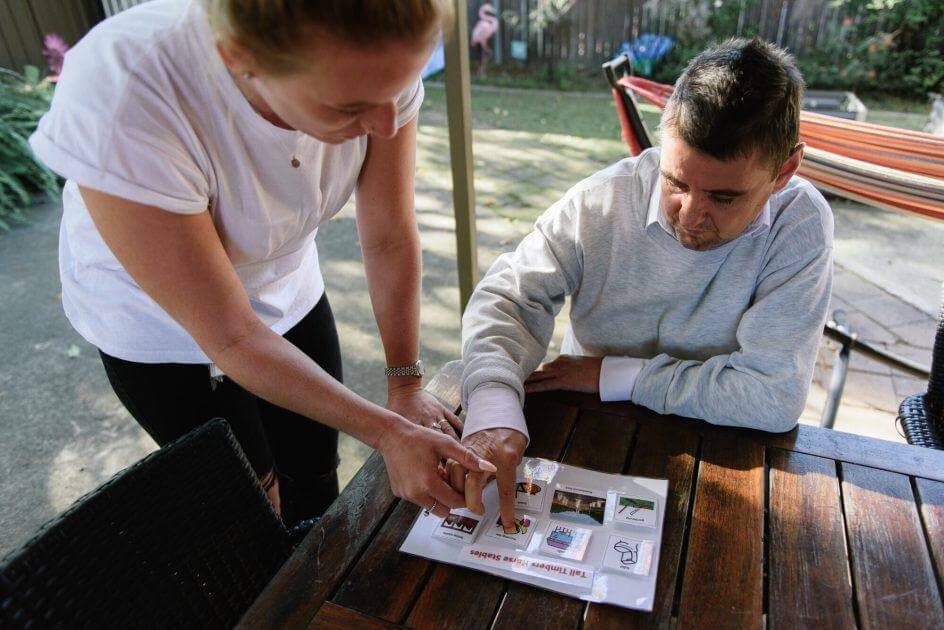
- Visual schedules and picture-based communication.
- Simple gestures or agreed signals.
- Clear, accessible instructions and information.
- Support from a speech pathologist where appropriate.
The aim is to help the person communicate more effectively and give others a better understanding of what they are trying to express.
Pain and Illness
Physical discomfort and illness can sometimes contribute to changes in behaviour, particularly when a person has difficulty describing what they are experiencing.
Possible causes include ear infections, dental pain, constipation, reflux, headaches or other health concerns.
For example, a person who becomes unusually withdrawn, distressed or irritable may be experiencing physical discomfort rather than responding to an environmental or behavioural trigger.
If a behaviour begins suddenly, changes significantly or has no obvious explanation, it is important to consider whether a health issue could be contributing. A GP or other appropriate health professional can help assess possible physical causes.
Sensory Needs
People with autism and other disabilities may process sensory information differently.
Sounds, lighting, textures, smells, physical contact and crowded environments can affect people in different ways. An experience that seems ordinary to one person may feel uncomfortable or overwhelming to someone else.
For example, fluorescent lighting, loud background noise, certain clothing textures or unexpected touch may contribute to sensory distress.
Understanding a person’s individual sensory preferences and sensitivities can help families and support workers make appropriate adjustments and reduce unnecessary sensory overload.
The Environment
The physical and social environment can also influence how a person feels and responds throughout the day.
Sometimes, relatively simple environmental adjustments can make everyday situations more manageable.
These may include:
- Reducing unnecessary background noise.
- Providing access to a quiet or calm space.
- Adjusting lighting where possible.
- Reducing visual clutter.
- Making routines and expectations more predictable.
- Preparing the person for changes in activities or surroundings.
The most useful adjustments will depend on the individual’s preferences and circumstances. Observing how a person responds to different environments can help identify changes that may make a meaningful difference.
How Families and Support Workers Can Respond Supportively
When a behaviour of concern occurs, the way family members and support workers respond can make a significant difference. The immediate priority is to maintain safety while helping the person feel supported rather than further overwhelmed.
Although every individual and situation is different, a few principles can help guide responses.
Stay Calm
Remaining calm can be difficult when a situation feels stressful or unpredictable. However, a steady and reassuring presence can help reduce additional pressure.
Raised voices, sudden movements or visible frustration may increase tension and make it harder for the person to regulate their emotions.
Try to keep your voice calm, use simple language and avoid reacting with anger or frustration.
Reduce Demands
When someone is already distressed, additional instructions or expectations may make the situation more difficult.
If it is safe and appropriate, temporarily reduce or remove the demand that may have contributed to the distress.
Allowing the person time to settle can be more helpful than insisting that an activity continue.
Avoid Reasoning During Moments of Distress
When someone is experiencing significant distress or sensory overwhelm, they may find it difficult to process explanations, instructions or lengthy conversations.
Rather than trying to reason with the person in the moment, focus on immediate safety, reducing demands and providing the space they need.
Conversations about what happened can take place later, when everyone is calmer and better able to reflect.
Give Space
Some people need physical and emotional space when they are overwhelmed.
Standing too close, maintaining intense eye contact or repeatedly asking questions may increase pressure.
Pay attention to the person’s preferences and allow them space where it is safe to do so. The right amount of support will depend on the individual and the situation.
Recognise Early Warning Signs
Many behaviours of concern have patterns that appear before the behaviour reaches its most intense point.
These early signs might include changes in facial expressions, increased restlessness, withdrawal, repetitive movements or changes in communication.
Learning to recognise an individual’s early warning signs can help families and support workers respond sooner and consider whether something in the environment needs to change.
Reflect Afterwards
Once the situation has settled, take some time to consider what happened.
Think about:
- What was happening immediately before the behaviour?
- Was there a change in routine or environment?
- Could the person have been experiencing pain, discomfort or sensory overload?
- How did others respond?
- What might help prevent a similar situation in the future?
The purpose of reflection is not to assign blame. It is to understand the person’s experience and identify ways to provide better support next time.
When to Seek Professional Behaviour Support
Some situations may be manageable with appropriate everyday support and environmental adjustments. However, professional behaviour support may be important when behaviours of concern become more frequent, intense or difficult to understand.
Consider seeking professional guidance when:
- Behaviours are becoming more frequent, intense or unpredictable.
- The person or others are experiencing physical harm or are at risk of harm.
- Restrictive practices, such as physical restraint or seclusion, are being used to manage behaviour.
- The behaviour significantly limits participation in community activities, education or work.
- Family members or carers are experiencing significant stress or burnout.
- Existing strategies are not helping and the support network is unsure what to try next.
A behaviour support practitioner can help assess the circumstances contributing to the behaviour and develop strategies suited to the person’s individual needs.
For NDIS participants, accessing appropriate NDIS behaviour support through a registered provider is particularly important when regulated restrictive practices are involved, as specific requirements and safeguards apply.
Seeking professional support is not a sign that a family or support worker has failed. It is a way to gain a better understanding of the person’s needs and develop a more consistent approach.

How Positive Behaviour Support Can Help
Positive Behaviour Support (PBS) is an evidence-based approach to understanding behaviours of concern and improving the quality of life of people with disabilities.
Rather than focusing only on stopping a behaviour, PBS looks at the factors contributing to it, including communication difficulties, sensory needs, environmental demands and unmet needs.
A positive behaviour support practitioner may:
- Conduct a functional behaviour assessment to understand the patterns and possible reasons behind a behaviour.
- Work with the participant and their support network to identify triggers and unmet needs.
- Develop an individualised behaviour support plan.
- Recommend preventative strategies and appropriate environmental adjustments.
- Support communication and skill development.
- Provide guidance to families, carers and support workers so they can respond consistently.
Positive Behaviour Support for Autism
For autistic children and adults, positive behaviour support can be particularly relevant when communication differences, sensory experiences, changes in routine or environmental demands contribute to distress.
Support may involve improving communication access, creating more predictable routines, adjusting sensory environments and helping the person develop ways to express their needs and preferences.
The approach should be individualised and respectful of the person’s communication style, autonomy and preferences.
At Your Positive Path, families can explore our Autism and ADHD Support services for support related to neurodiversity, as well as our Therapy and Emotional Support services for carers and family members who may also need support.
Frequently Asked Questions
Are behaviours of concern always linked to disability?
Not necessarily. However, within the NDIS context, the term is used in relation to people with disabilities whose behaviour creates a risk of harm or significantly affects their participation and quality of life.
The strategies discussed in this article focus on understanding and supporting people within a disability support context.
What if the behaviour has only just started?
A sudden change in behaviour may indicate that something has changed in the person’s health, environment, routine or support arrangements.
Rather than immediately assuming it is a behavioural issue, consider whether the person may be experiencing pain, illness, discomfort or another change in their circumstances. If the change is sudden or concerning, seek advice from an appropriate health professional.
Can behaviour support strategies be used at school as well as at home?
Yes. Consistency across different environments can be an important part of positive behaviour support.
Where appropriate, a practitioner may work with family members, support workers, schools or day programs to help everyone understand the person’s needs and follow compatible strategies.
This can make support more predictable for the individual across different parts of their daily life.
What if my family member doesn’t have an NDIS plan yet?
You can still contact a provider to discuss your concerns and understand what support options may be available.
If behaviours of concern significantly affect a person’s daily life and are related to their disability-related support needs, relevant information may also be useful when preparing an NDIS access request.
The NDIS has specific eligibility and evidence requirements, so individual circumstances should be considered.
Understanding Is the First Step
Supporting someone who experiences behaviours of concern can be challenging for families, carers and support workers. It can involve uncertainty, emotional stress and situations where it is difficult to know what response will help.
However, taking the time to understand what may be contributing to a behaviour can change how these situations are approached.
By recognising possible triggers, considering unmet needs, improving communication and making appropriate environmental adjustments, families and support workers can develop more supportive ways of responding.
Your Positive Path supports individuals, families and carers across Truganina, Hoppers Crossing, Werribee, Tarneit, Point Cook and the wider western Melbourne region through positive behaviour support, psychology and occupational therapy services.
If you would like to explore support options, get in touch with Your Positive Path to discuss how we may be able to help the person you support and your family.